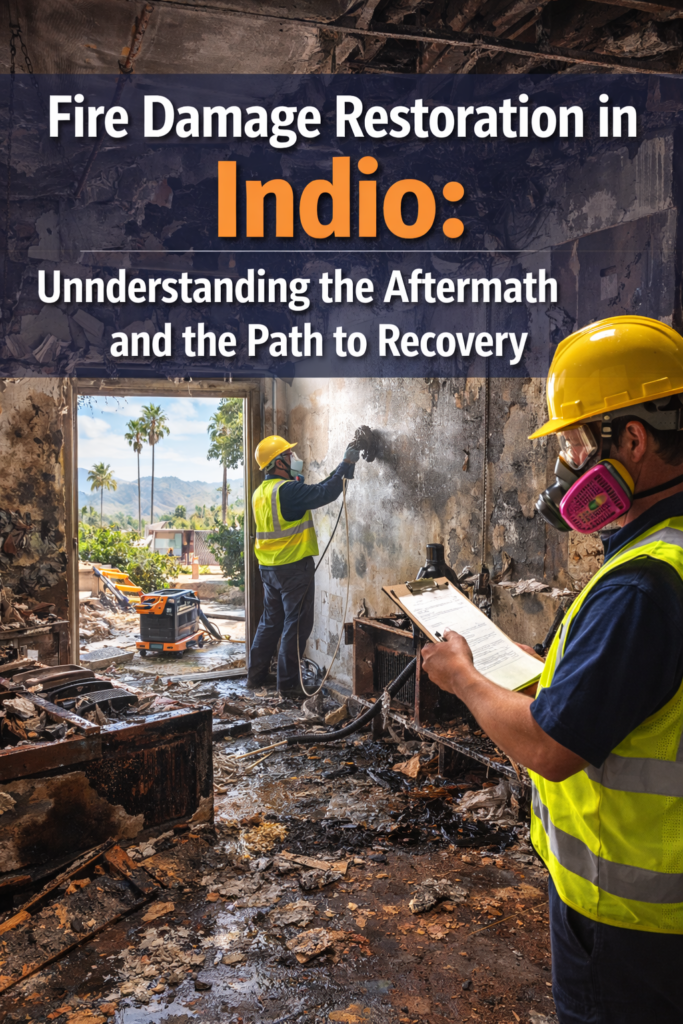
A fire is among the most devastating events a property can experience. Even a fire that is contained quickly leaves behind a complex web of damage not just from flames, but from smoke, soot, heat, and the water used to extinguish it. In Indio, California, where dry desert conditions can accelerate fire spread and complicate recovery, understanding what Fire Damage Restoration Indigo involves is essential knowledge for homeowners and business owners alike.
The Multiple Dimensions of Fire Damage
Fire damage is rarely limited to the area where flames were present. The thermal energy of a fire causes structural materials to weaken, warp, or fail. Smoke travels far beyond the fire’s origin, depositing soot on surfaces throughout the building and penetrating into ductwork, insulation, and porous materials. The acidic compounds in smoke begin attacking metals, fabrics, and finishes within hours of a fire which is why restoration professionals treat post-fire environments as time-sensitive.
Water damage from firefighting efforts adds another dimension. Large volumes of water discharged during suppression saturate floors, walls, and ceilings, creating conditions for mold growth if not promptly addressed. In severe cases, the structural integrity of the building itself must be assessed before any restoration work can safely begin.
The Fire Damage Restoration Process
Professional fire damage restoration follows a comprehensive sequence. Emergency board-up and tarping services are typically the first step securing the property against weather, vandalism, and unauthorized entry in the immediate aftermath of a fire. This protective step preserves whatever can be salvaged while the restoration plan is developed.
A detailed damage assessment follows, during which restoration specialists document all affected areas, categorize the type and severity of damage, and develop a scope of work. This documentation is also essential for insurance claims purposes. Professional teams use specialized testing equipment to identify smoke penetration depth and determine which materials can be cleaned versus which must be replaced.
Smoke and soot removal is a technically demanding part of the process. Different surfaces require different cleaning approaches dry chemical sponges for certain materials, wet cleaning for others, and thermal fogging or ozone treatment for odor elimination. Soot that is not properly removed can continue to cause corrosion and discoloration long after a fire.
Structural Assessment and Safety
Before restoration work proceeds in earnest, the structural safety of the building must be evaluated. Fire weakens materials in ways that may not be immediately visible. Wooden beams and joists can char through appearing intact on the surface while having lost significant load-bearing capacity. Concrete can spall when exposed to intense heat. Steel connections can warp. A qualified professional must assess these structural components before workers or residents re-enter the building.
In California, this evaluation typically involves coordination with local building officials and may require engineering assessments for heavily damaged structures. Demolition of irreparably damaged sections whether walls, ceilings, or floors is often necessary before reconstruction can begin.
Restoring Contents: What Can Be Saved?
One question property owners consistently ask after a fire is what can be salvaged from their belongings. The answer depends on the type of material, the intensity of exposure, and how quickly professional intervention begins. Non-porous items such as glass, metal, and ceramics can often be cleaned and restored. Electronics require specialized assessment. Clothing and soft furnishings may be restorable through professional ozone or ultrasonics cleaning.
Porous materials upholstered furniture, books, paper documents, and items deeply saturated with soot are generally more difficult to restore. A contents restoration specialist inventories and evaluates items, separating what can be cleaned from what must be replaced. This inventory also serves as documentation for insurance claims.
Fire Safety in Indio’s Desert Environment
Indio’s climate characterized by hot, dry summers and Santa Ana wind conditions in autumn creates elevated fire risk, particularly for properties near open desert areas. Defensible space maintenance, which involves clearing combustible vegetation from around structures, is an important fire prevention measure for Indio homeowners. Inside the home, working smoke detectors, updated electrical systems, and proper storage of flammable materials all reduce fire risk.
When a fire does occur, the speed and professionalism of the restoration response have a direct bearing on outcomes both in terms of what can be saved and how quickly a property returns to a safe, habitable state.